The Life Roles of St. Bridget of Sweden as an Outstanding Model of 'Feminine Holiness'
Pilgrim, wife, mother, royal advisor, mystic, writer, and patroness of Europe – Bridget of Sweden was authoritative in leadership yet gentle in her approach. In her own court, she lived poverty of spirit and remained faithful in faithless times. She is a realistic example of navigating and alternating a woman's roles throughout different phases of life. In a time when social media offers content titled "realistic routines", introducing us to routines of sameness and obligation – reading the life of this saint reveals that only the routine of a daily relationship with God gives the order, measure, time, and strength for the mission He has for each of us.
Faithfulness and patience in our current season of life guide us toward the new roles prepared for our future. Some life roles – are waiting, while playing our current ones trains us for the new ones in another season. Wisdom lies in learning to play and fully live the present.
The profound impact of St. Bridget, and her place among the greatest women of the Catholic Church, is best expressed in the words of Pope John Paul II., who proclaimed her Co-Patroness of Europe and highlighted her as a model for women on the path of sanctification:
"In proclaiming St. Bridget Co-Patroness of Europe, I wanted to offer the faithful of the continent an outstanding model of 'feminine holiness'. After living happily as a faithful wife, exemplary mother, and wise educator, Bridget experienced holy widowhood and finally reached the state of consecrated life. At every stage of her life, she wisely knew how to combine contemplation with wide-ranging activity, sustained by love for Christ and the Church."
One of the most famous pilgrims to the Holy Land alongside St. Francis of Assisi, to whose Secular Order she belonged, and one of the most prominent women of the 14th century, was Bridget of Sweden. A wife and mother of eight children, but also a writer with hundreds of pages of her own mystical writings, a critic, and an advisor to the kings of Sweden, Italy, and many Church leaders. From mystical experiences, she would shift to solving tasks at court and on the farm, raising children, and making plans with her husband. She faithfully accepted and fulfilled the tasks of a daughter of the Father, a bride of Christ, Ulf's wife, a mother of eight, and many others.
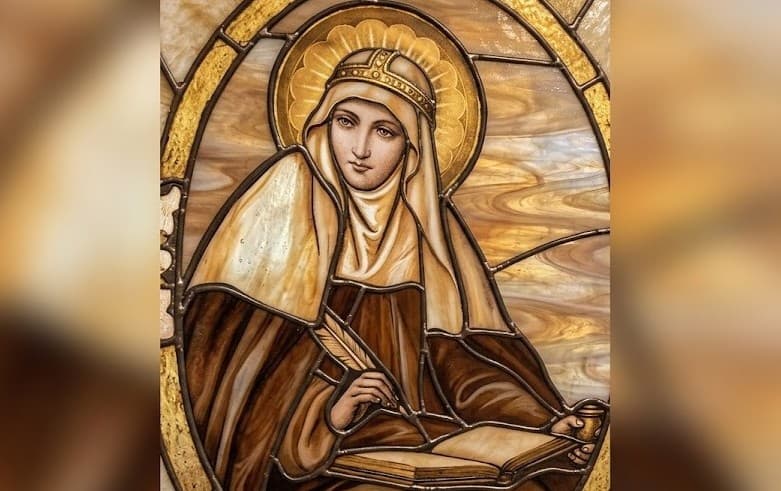
Much was given to her, but she knew – that much would be required of her (cf. Lk 12:48). The future saint and Co-Patroness of Europe was born in the Swedish town of Finstad in 1303. She grew up in a Catholic noble family; her mother was Ingeborg and her father Birger, who was the chief judge of the region where they lived. From her father, she inherited fearlessness and astuteness, a diplomatic attitude, and communication skills. Already at the age of seven on the family farm, she had her first mystical experience with Jesus and Mary. At thirteen, an arranged marriage was made with Ulf Gudmarsson, a nobleman a few years her senior, with whom, despite the arrangement, she had a peaceful life filled with joy. They had eight children: Karl, Martha, Gudmar, Bengt, Cecilia, Birger, Ingeborg, and Catherine, who was always by her mother's side, continued her work, and was proclaimed a saint.
Her Revelationes, is one of the most influential theological and mystical works. It was written over three decades and consists of eight books. It is divided into thematic sections where Bridget writes about visions and revelations of Jesus, Mary, the Heavenly Father, St. Francis, and St. Agnes, describing many other encounters as well. The Revelations provoked intrigue and divided opinions due to the political messages, warnings, and advice she delivered to the clergy and the Church, as well as to European rulers, including the Swedish King Magnus and the powerful Queen of Naples. These letters are found in Book VIII, titled Caelestis Imperatoris ad Reges (The Book of the Heavenly Emperor to the Kings), and in Book IV.
The words she received in private revelations carried the weight of reprimand and change. Bridget successfully bore the weight of that cross – with full trust in the Father who asked this of her. Those to whom she brought messages seeking peace and a change of heart, appealing to the teachings of the Church, mostly resented her words, but they ultimately accepted and respected them. There were those who criticized and condemned Bridget for acts of witchcraft, but also those who stood firmly in her defense, using Church documents and the writings of the Church Fathers to defend her work and the holiness of her life. Thus, at the Council of Basel, about fifty years after her death, her Revelations were put on trial. But as it happens in the lives of the saints, God sends His people and shows His strength through His chosen messengers on earth. At the Council, the famous Spanish theologian Juan de Torquemada presented his research summarized in his work of defense called Defensorium revelationum sanctae Birgittae. Out of 123 disputed points, he defended every single one, citing Sacred Scripture, St. Thomas Aquinas, and St. Augustine.
Many Church leaders later reviewed her work, and the Church declared it authentic, without delving into the details of the revelations and leaving it to the faithful to choose whether to believe in these private revelations. Pope John Paul II confirms this in his Apostolic Letter Spes aedificandi (which will be mentioned later in the text).
The political entanglements and church situations she entered were extensive, but what was crucial for Bridget was that, despite the fears and strains of her spiritual life, she persevered in what she started. The words Jesus spoke to her: "Do not turn back until you reach the top of the mountain! There is nothing so difficult that it does not become easy through constant and reasonable perseverance. There is no quest so noble in the beginning that does not fall into darkness if it is not brought to completion. Therefore, step toward spiritual wisdom! It will lead you to physical labor, to contempt for the world, to a little pain, and to eternal consolation," restored her hope and strength. With small steps, she walked from rulers to the poor, to her own children and husband, to courtiers and the needy, to distant lands and deeply cherished friendships.
The Lord Himself taught her about spiritual wisdom – she had that privilege. He spoke to her about the biblical female figures, Martha and Mary. The secrets revealed to her heart are truths we can apply to our own lives. In brief words, Jesus teaches Bridget that one must first be Martha and do physical work for His glory.
The suffering of the body is a prerequisite for spiritual wisdom.
He speaks these words to her: "For he who is untested and untempted, and he who has not overcome the desires of his body, how can he constantly attend to heavenly things and choose them? Who is the dead brother of Mary and Martha but an imperfect work? For often a good deed is done with a rash intention and an unthinking heart, and thus it is done sluggishly and slowly. But for the doing of good works to be acceptable to Me, Martha and Mary must raise and revive it." Mary comes after Martha; ascending through prayer and the knowledge of the heart to that lofty mountain the Father spoke of.
Bridget is an example of the model that was showed to her. Because of her revelations and the sweetness of prayer, she never slowed down her daily tasks or delayed her own obligations. Contemplation and the encounter with God during the Holy Eucharist were the center of her life. She drew strength from contemplating Christ's Body and weaknesses. She deeply desired to know the number of blows He endured on His body, and in answer to her persistent prayer, Jesus told her that He received 5,480 blows on His body. He added that if she wished to honor His wounds, she should pray for a year the 15 prayers He gave her, along with 15 Our Fathers and Hail Marys. After a year, every wound of Jesus would be honored. Jesus' passion was not the only one Bridget "walked" with; she wanted to be a co-sufferer of Mary's pain, and so Our Lady told her: "I look upon all the people living on earth to see if anyone would pity me and reflect on my sorrow, but I find very few. Therefore, my daughter, though many forget me, do not forget my sufferings. Meditate on my pain and imitate my sorrow as much as you can." Bridget encouraged the devotion to the Seven Sorrows of Mary – a beautiful prayer/novena that had long been forgotten. These are powerful prayers through which numerous graces and insights are granted and revealed to those who pray with their heart and share the Mother's pain in contemplating the passion of her Son.
Interestingly, amidst all this, Bridget was also a pilgrim. Many today lack the opportunity or courage to cross the miles this woman managed to walk during her lifetime. In that era, without technology or modern transport, she walked the paths of El Camino with her husband to visit St. James. With her daughter Catherine, she frequently visited Rome. Such pilgrimages lasted for weeks and months.
Every fall and adversity was a new opportunity for growth.
She first walked through her own country, creating steps that today form the route bearing her name. Today, Bridget has her own route, the Birgittaleden, complete with special passports, tailored accommodations, and maps. The paths lead to her relics. In her revelations, Jesus' words are recorded, addressed to her during her stay in the city of Ortona in Naples, instructing her to also visit the relics of St. Thomas Aquinas: "I find the sweetest joy in these relics and in the relics of My other saints, considering such relics My precious treasure on earth and promising great merit and reward to those who venerate them with due devotion." Today it is nice to imagine being a pilgrim, but one who decides to take such steps is aware of the challenges that require physical, mental, and especially spiritual effort. It is a walk to which He calls. Bridget knew this and awaited God's call for new steps.
She did not choose the path, destination, and time herself. When her limbs grew tired and her strength began to fade, Jesus called Bridget on a new pilgrimage to the places where He was born, grew up, and suffered. The call caused the saint insecurity – for she was already older. The Mother of God comforted her and invited her to practice patience, to await the moment when it was God's will to send her on a new pilgrimage.
"As soon as she understood God's will, she directed her path according to His commandments. At every moment, she was careful to let nothing distract her from God. She was careful, when those around her spoke of their ambitions, successes, or failures, not to become less devout in her service to God. Anything contrary to God's law she immediately recognized as a danger to be avoided at all costs. With such practice and discipline, everything she did was good. She paid attention to every detail that needed to be worked out before a pilgrimage. Everything she said, everything she listened to, everything she gave her attention to, was reasonable and wise. Her work was useful to her and others, and every journey she made had a good reason."
In the mentioned Apostolic Letter Spes aedificandi of October 1, 1999, Pope John Paul II writes: "I noted that the saint was appreciated for her gifts as a teacher, which she was able to use when she was required to serve at court in Stockholm. This experience was the basis of the counsel which she would later give from time to time to princes and rulers concerning the proper fulfillment of their duties. But obviously, the first to benefit from these counsels were her children, and it is not by chance that one of her daughters, Catherine, is venerated as a saint. What a precious example for families of our time!" Indeed, during the canonization process, her daughter Catherine said that her mother never sat down to eat at the table without first feeding twelve others – the poor. She strove to serve so that the great, the poor, her family, and above all, the dear God, would benefit from her gifts and talents. In the same Apostolic Letter, the Pope states that in anticipation of the new (third) millennium, we must be aware that human efforts mean nothing if they are not accompanied by divine grace.
"Unless the Lord builds the house, the builders labor in vain" (Ps 127:1).
The Pope speaks of the history of Europe and the crisis it was/is in, but also of the roots of Christianity and unity. The Pope writes: "In the building up of Europe, Christians have a duty to make a specific contribution, which will be all the more valid and effective the more they themselves are renewed in the light of the Gospel. In this way, they will carry forward that long history of holiness which has traversed the various regions of Europe over these two millennia, in which officially recognized saints are merely the towering peaks set as a model for all. For by their upright and honest lives inspired by love for God and neighbor, countless Christians in a wide spectrum of consecrated and lay vocations have achieved an authentic and widespread holiness, even if often hidden." He goes on to describe the connection between nations and patron saints, as well as the possibility of a saint's patronage over a continent. At that time, the Pope decided, alongside the three male patrons of Europe: Benedict, Cyril, and Methodius, to proclaim St. Bridget of Sweden, St. Catherine of Siena, and St. Teresa Benedicta of the Cross (Edith Stein) as Co-Patronesses. He continues: "Three great saints, three women who at different times – two in the very heart of the Middle Ages, and one in our own century – distinguished themselves by their fruitful love for Christ's Church and their witness to His Cross. Naturally, the horizons of holiness are so rich and varied that new heavenly patrons could have been chosen from among other worthy figures in whom every age and region can take pride. Nevertheless, I consider the decision to choose this 'feminine' model of holiness particularly significant within the context of the providential tendency in the Church and society of our time to recognize ever more clearly the dignity and specific gifts of women. The Church from her very beginnings has not failed to recognize the role and mission of women, even if she was sometimes conditioned by a culture that did not always show due consideration for them. But the Christian community has progressively matured in this regard as well, and here the role of holiness has proved decisive. A constant stimulus has come from the icon of Mary, the 'ideal woman', Mother of Christ and Mother of the Church. But also from the courage of female martyrs who faced the most cruel torments with astonishing strength, the witness of women exemplary in their radical commitment to the ascetic life, the daily dedication of countless wives and mothers in that domestic Church which is the family, and the charism of numerous female mystics who have also contributed to the growth of theological understanding, offering the Church invaluable guidance in fully grasping God's plan for women. This plan is already unmistakably expressed in certain pages of Sacred Scripture and, above all, in Christ's own attitude as testified by the Gospel. The decision to proclaim St. Bridget of Sweden, St. Catherine of Siena, and St. Teresa Benedicta of the Cross as Co-Patronesses of Europe flows from all of this."
Of all the saints and faithful women throughout all centuries, the Pope carefully selects these three. We will write much more about St. Edith and St. Catherine. But it is important to mention, alongside the relationship between St. Bridget and her daughter Catherine, the relationship with St. Catherine of Siena. During her pilgrimages to Rome, and especially in the last two years of Bridget's life, Catherine met people of faith in Rome; that city became her second home. The two Catherines later became very good friends, perhaps even best friends. One from Sweden, and the other from Siena – distance did not prevent the friendly love and closeness of souls whom God chose for their individual, but also shared, missions. In their relationship, history also records some hesitations and advice, criticisms they directed at each other, encouraging one another toward a virtuous life and courage in living the faith and confronting the problems of society and the Church of that time.
There is no path of holiness without challenges in interpersonal relationships.
History records much, but without love that endures despite misunderstandings and weaknesses – there is no peace and eternal light. It remains for us to study and reflect upon the inexhaustible situations and roles in which Bridget and the women around her found themselves. Furthermore, to take from her biography and written legacy what could be useful and encouraging to us.
I will conclude again with the words of Pope John Paul II addressed to the Mother General of the Brigittine Order, Tekla Famiglietti: "In proclaiming St. Bridget Co-Patroness of Europe, I wanted to offer the faithful of the continent an outstanding model of 'feminine holiness'. After living happily as a faithful wife, exemplary mother, and wise educator, Bridget experienced holy widowhood and finally reached the state of consecrated life. At every stage of her life, she wisely knew how to combine contemplation with wide-ranging activity, sustained by love for Christ and the Church. She brought truly feminine gifts to the Christian community of her time, and as a completely fulfilled woman, she put herself at the service of others. Her example can serve as an effective encouragement for women today to be protagonists in a society in which women's dignity is fully respected; a society that will regard men and women as protagonists of equal importance for the universal divine plan for humanity. It suffices to skim through the biography of this woman, who combined the most exalted contemplation with the most courageous apostolic initiatives, to realize that Bridget can still offer useful guidance for women today on appropriate ways to face problematic views of the family, the Christian community, and society itself."
I believe there are still no wiser words describing St. Bridget – the Co-Patroness of our continent, so humble yet so great in Heaven. May the example of Bridget of Sweden and the encouraging words of St. John Paul II be a reminder of the unique path of holiness and a stimulus to do good.
Next year, we are planning a pilgrimage specifically tied to the life of St. Bridget and those closest to her, combined with the path of some other great – lesser-known, but not less important – Italian female saints. It will be a special pilgrimage thematically focused on healing the relationships of mothers and daughters, friends, female colleagues, forgiveness, and love in impossible situations. In order to make a change and be of use to others, it is first necessary to begin healing our own hearts and doing good for ourselves. If you want to know what kind of pilgrimage this is and join the registration waitlist that we will publish soon, subscribe to our .
Author: Ivana A.